In today’s digital age everyone can see that Artificial Intelligence is changing the way the world works, but you should also know that there are many ongoing changes in AI/ML to make it better. In this rapidly evolving landscape of Artificial Intelligence (AI) and Machine Learning (ML); Multi-Agent Collaboration has become a very important technique for successfully scaling any enterprise-level project. This means that when we try to solve complex problems, a single Large Language Model (LLM) often runs into its limitations, such as context window limitations, reasoning bottlenecks and hallucinations.
This is where the role of Multi-Agent Collaboration begins. In this article we will deeply understand how you can design an effective Autonomous AI Agents Workflow and what serious mistakes you should avoid while scaling it. Its demand is very high today so having good knowledge about it is very important. So let’s understand it in detail:
What is Multi-Agent Collaboration and why is it important?
In simple words Multi-Agent Collaboration is an architecture where multiple specialized AI agents work together to complete a large and complex task. Each agent is given a specific role, tools and instructions. It works just like a software development team where a project manager, a developer and a tester work together to build software.
For AI/ML professionals Collaborative AI Systems for Automation is not just a concept but the backbone of production-grade applications like LangGraph, CrewAI and AutoGen. This architecture not only improves accuracy but also reduces the time required to execute tasks.
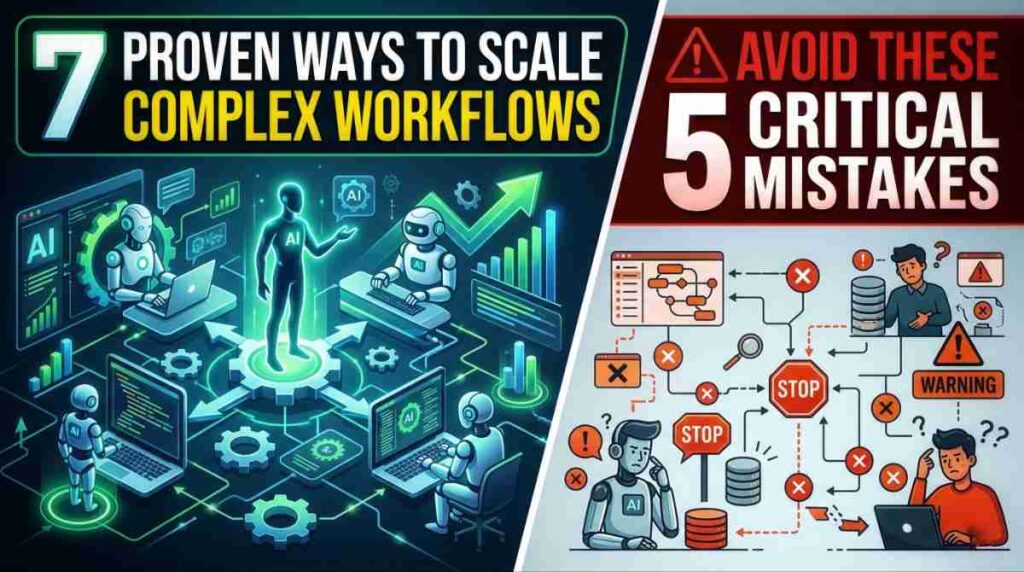
7 Proven Ways to Scale Complex Workflows Using Multi-Agent Collaboration
Today it has become necessary for every AI/ML professional to understand Multi-Agent Collaboration. If you want to automate and scale complex workflows in your AI projects, the 7 proven methods given below will be extremely valuable for you:
1. Task Decomposition and building Specialized Agents
The first rule of scaling any large workflow is to break it into smaller parts (Task Decomposition). This means that instead of making a single agent handle research, coding and testing, you should create separate domain-specific agents.
- Role Definition: Each agent should have a clear system prompt that defines its expertise.
- Micro-Agent Architecture: When using Multi-Agent Collaboration, a “Researcher Agent” should only focus on finding data while a “Writer Agent” should focus on structuring that data.
- Efficiency: This approach reduces complexity in an Autonomous AI Agents Workflow and keeps each agent’s focus clear which improves the overall output quality significantly.
2. Adopting Hierarchical and Router-Based Architecture
When you have multiple agents, establishing coordination between them becomes a challenge. To solve this problem, using a hierarchical architecture is the most effective approach.
- Supervisor Agent: Create a “Supervisor” or “Manager” agent. Its only job is to understand the user’s request and route it to the correct worker agent.
- Directed Acyclic Graphs (DAGs): By using frameworks like LangGraph, you can build a state machine where the workflow flow works as nodes of a graph.
- Scalability: This approach allows Multi-Agent Collaboration to scale smoothly because you can easily add new worker agents without breaking the workflow.
3. Optimizing Shared Memory and Context Management
In an Autonomous AI Agents Workflow, the biggest technical challenge is how agents share information so that they do not process the same thing repeatedly.
- Global State vs Local State: Maintain a global state where shared data of all agents is stored. At the same time, each agent should also have its own local memory.
- Using Vector Databases: For long-term memory, use vector databases like ChromaDB, Pinecone or Qdrant.
- Context Window Optimization: In Multi-Agent Collaboration, ensure that one agent passes only necessary information (summary or extracted data) to another agent, not the entire raw data. This saves tokens and reduces latency.
4. Implementing Asynchronous Communication

If your agents keep waiting for each other (synchronous mode), the entire workflow will become slow. For large-scale operations, asynchronous communication is essential.
- Parallel Execution: Execute tasks that do not depend on each other at the same time (in parallel). For example, in a multi-agent system, two different research agents can perform web searches simultaneously.
- Message Queues: As the number of agents increases, using message brokers like Kafka or RabbitMQ can make Collaborative AI Systems for Automation more stable and faster.
- Event-Driven Workflows: Make the workflow event-driven instead of time-based so that as soon as one agent finishes its task, the next one can immediately start working.
5. Robust Tool Calling And API Integrations
A well-designed Multi-Agent Collaboration system is effective only when its agents can interact with the external world.
- Custom Tools: Do not limit agents to just text generation. Give them access to tools like Python REPL, Web Search APIs such as Tavily or SerpApi and database query tools.
- Strict Output Parsing: When an agent uses a tool, parse its output using JSON or Pydantic models so that the next agent can easily understand it.
- Tool Error Handling: If a tool fails, the agent should have the ability to adopt a fallback strategy to complete the task. This makes the Autonomous AI Agents Workflow more reliable.
6. Integrating Human-in-the-Loop (HITL) Mechanism
Automation does not mean completely removing humans from the process. In a production environment, Human-in-the-Loop is very important to ensure safety and quality.
- Approval Nodes: Create checkpoints in the workflow where human approval is required before making important decisions (such as deleting something from a database or sending an email).
- Feedback Integration: When a human operator makes a correction, the agents should be programmed to store that feedback in their memory and avoid repeating the same mistake in the future.
- Trust and Safety: Implementing HITL in Collaborative AI Systems for Automation increases stakeholders’ trust in the system and reduces the risk of unexpected outputs.
7. Continuous Reflection and Self-Correction (Self-evaluation)
One of the biggest strengths of a scalable Multi-Agent Collaboration system is its ability to identify and correct its own mistakes.
- Critic Agent: Include a “Critic” or “Reviewer” agent in your workflow. When a worker agent produces an output, this reviewer agent evaluates it.
- Iterative Refinement: If the output does not meet the system requirements, the reviewer agent sends it back to the worker agent with feedback.
- Dynamic Prompt Adjustment: Due to self-correction loops, the Autonomous AI Agents Workflow becomes smarter and more accurate over time, eventually reducing the need for manual intervention.
Avoid These 5 Critical Mistakes in Multi-Agent Collaboration

When developers and AI engineers design Collaborative AI Systems for Automation for the first time, they often make some common but serious mistakes. If you avoid these mistakes then your system can be protected from crashing.
1. Ignoring Infinite Loops and Deadlocks
The most common mistake is leaving communication between agents without any limits.
- Problem: When two agents disagree with each other’s output, they may keep prompting each other repeatedly, creating an infinite loop. This can exhaust your API credits within minutes.
- Solution: Always set a max_iterations or max_execution_time parameter in your Multi-Agent Collaboration architecture. If the agents do not reach a conclusion within a defined limit, stop the process and alert a human operator.
2. Over-Engineering (Creating more agents than necessary)
Sometimes engineers create too many agents thinking it will make the system smarter.
- Problem: Having too many agents significantly increases system latency and makes the architecture unnecessarily complex.
- Solution: Always start with the minimum viable agents. Add a new agent in an Autonomous AI Agents Workflow only when the existing agents repeatedly fail to handle a specific task.
3. Not managing Context Length Limits (Token Limits) properly
LLMs have a limited context window.
- Problem: When agents pass messages to each other, the conversation history becomes very long. If you send the entire history to every agent each time, you will quickly exceed the LLM’s token limit and the system will crash.
- Solution: In Multi-Agent Collaboration, use the “Message Summarization” technique. Instead of sending the entire raw data from one agent to another, use a “Summarizer Agent” to pass only the key insights forward.
4. Overlapping Responsibilities
If the system prompts of agents are not clear, it creates confusion in the system.
- Problem: Suppose you have a “Data Analyst” agent and a “Financial Expert” agent. If their prompts do not clearly define who will process the data, they may interfere with each other’s work or perform the same task twice.
- Solution: While designing Collaborative AI Systems for Automation, strictly define the responsibilities and boundaries of each agent. Make sure their scope does not overlap.
5. Ignoring Security and Access Control
As AI systems gain autonomy, security risks also increase significantly.
- Problem: If an external user performs a “Prompt Injection” in your system and one of your agents accepts that malicious input, it can damage your database or leak sensitive information.
- Solution: Use strict sandboxing for tool execution in an Autonomous AI Agents Workflow. Follow the “Principle of Least Privilege,” meaning give each agent only the minimum rights (read/write access) necessary for its task.
The future of Collaborative AI Systems for Automation
For professionals working in the field of AI and Machine Learning, it is extremely important to understand that Multi-Agent Collaboration is not just a temporary trend but the future of software engineering. As models become more capable and cost-effective, we will see entire software development life cycles (SDLC), marketing campaigns and data engineering pipelines being fully managed by autonomous agents.
As an AI/ML engineer if you master Autonomous AI Agents Workflow, you can not only improve system efficiency but also solve complex problems that were impossible with traditional programming or single-prompt LLM approaches.
While designing your workflow, always use the 7 proven methods mentioned above and implement guardrails from the beginning to avoid the 5 serious mistakes. With the right strategy, strong system prompting and effective state management, your Collaborative AI Systems for Automation will not only be scalable but also production-ready.